The buyer who exists in four places at once
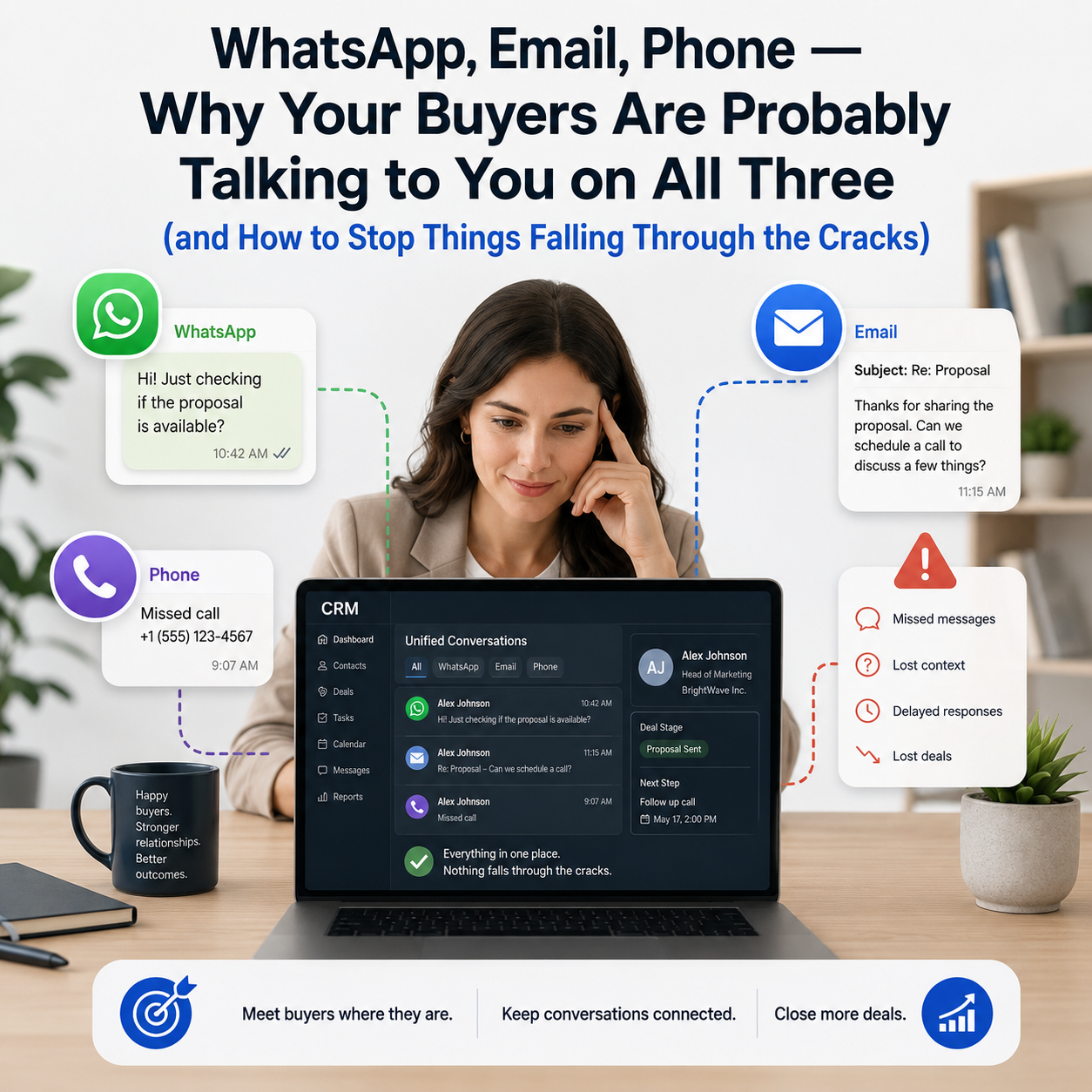
It starts innocently enough. A buyer finds your listing on a portal and sends an email enquiry. You respond, exchange a few messages, then agree to a call. After the call, they text you a follow-up question. A week later they drop you a WhatsApp because it's quicker than email and they know you'll actually see it.
Now their contact history is split across your inbox, your call notes (if you wrote any down), and your personal WhatsApp. When you go to brief a colleague, or when that colleague picks up the phone while you're out, nobody has a complete picture. The buyer has to repeat themselves. The trust starts to fray.
This is one of the most common — and most quietly damaging — problems in business transfer and commercial agencies. It isn't dramatic. There's no obvious disaster. Deals just take longer, or quietly die, and nobody quite knows why.
Why commercial buyers in particular communicate this way
In residential, a buyer typically gets in touch, books a viewing, makes an offer, and follows a fairly linear path. In commercial and business transfer work, the journey is far more iterative. A buyer might spend weeks asking questions before they're ready to sign an NDA. They circle back after months of silence. They forward your details to a business partner who then contacts you from a different number entirely.
That complexity means communication rarely stays in one tidy place. Buyers use whatever feels natural to them in the moment — and for a growing number of people, that means WhatsApp as much as email. It's immediate, it's informal, and it doesn't require them to fish through a long email thread to find the attachments from last month.
The challenge for agencies is that "whatever feels natural to the buyer" doesn't automatically fit into a neat, searchable record on the contact file.
The hidden cost of scattered conversations
When communication is fragmented, a few things tend to happen regularly:
- Duplicate effort. Two agents end up chasing the same buyer because neither can see what the other has already said.
- Dropped context. A buyer mentions in WhatsApp that they need to complete before the end of the tax year. That detail never makes it into the CRM. Three weeks later, nobody remembers.
- Slow response times. A message sitting in a personal WhatsApp doesn't trigger any of the follow-up workflows your CRM would normally manage.
- Compliance gaps. In business transfer work especially, there are audit trails to consider. If a buyer later disputes what was discussed, "I'm pretty sure I mentioned it on WhatsApp" is not a robust defence.
None of this is catastrophic in isolation. Collectively, it adds up to deals that take longer to close and clients — both buyers and vendors — who feel less confident in your service.
What a joined-up approach actually looks like
The practical goal is straightforward: every meaningful conversation, regardless of channel, should end up linked to the right contact record. That way, anyone in the team can open a buyer's file and see the full picture — emails, call notes, WhatsApp threads, portal enquiries — without hunting through three different apps.
Achieving that used to require quite a bit of manual discipline: copy-pasting WhatsApp messages into a note, logging calls immediately rather than "later", keeping personal and work messaging firmly separate. Many agents develop good habits around this. Many others mean to but don't quite manage it when things get busy.
The more reliable solution is to route communication through channels that are already integrated with your CRM. When a WhatsApp message arrives, it should land in a shared inbox that's linked to the contact record, not in a negotiator's personal phone. When a call is logged, the summary should attach automatically. When a buyer replies to an email, the thread stays in the system rather than migrating to a personal Gmail account.
This is precisely why Agency Office has built native WhatsApp and Facebook Messenger integration directly into the platform — so that messaging conversations sit alongside emails and call notes on the same contact file, visible to the whole team without anyone needing to forward or copy anything manually.
Practical steps you can take right now
Even if a fully integrated setup is still on the horizon for your agency, there are habits worth building today:
- Audit where your buyer conversations actually live. Spend ten minutes listing every channel that buyers use to reach you. Email, portal messages, WhatsApp, SMS, phone, LinkedIn — note them all. You may be surprised.
- Create a "log it now" culture. If a buyer says something significant on a call or in a personal message, log it in the CRM before moving on. A 30-second note beats a forgotten detail every time.
- Use a shared team inbox for inbound enquiries. Personal inboxes are silos. A shared inbox means enquiries can be picked up, assigned, and tracked without relying on one person being available.
- Agree on where WhatsApp fits in your process. Some agents are happy for buyers to WhatsApp them directly; others prefer to keep it to a business number. Either can work — but the policy should be deliberate, not accidental.
- Review your contact records regularly. A contact file with no notes and no communication history is a red flag. Make it part of your pipeline review to spot records that have gone quiet without explanation.
The bigger picture
Buyers choose the channel that's easiest for them, and that isn't going to change. The agencies that handle multi-channel communication well aren't necessarily working harder — they've just built systems that make it easy to stay organised regardless of how a conversation starts.
For a two- or three-person team, that might simply mean better habits and a shared inbox. For a growing agency, it means choosing technology that was designed to handle this from the start, rather than patching together a workaround after the fact.
Either way, the principle is the same: the conversation belongs in the deal file, not in someone's back pocket.
Book a 20-minute demo to see how Agency Office handles multi-channel conversations in a live workflow.